Space to Grow: Tackling Aging Infrastructure, Capacity Strains and Financial Pressures in Healthcare Design


While health systems across the globe face capacity constraints, NBBJ’s team of healthcare consulting leaders explores four common, big-picture challenges that arise during facility planning and design. From aging buildings to collisions between mission and profitability, NBBJ’s experts explain how tools like simulation modeling can help health systems efficiently meet their communities’ needs.
Despite a focus on preventative care, the shift from inpatient to outpatient services, and the transition to virtual care, hospitals worldwide continue to struggle with capacity constraints. As a result, many systems are thinking creatively about current and future space needs.
As a leading healthcare design firm, our role is to help organizations devise strategies to simplify decision-making.
Previously, we introduced the ‘next-gen master plan’—a flexible framework empowering health systems to renovate, pivot, or build as needed. Here, we take a step back and unpack four common issues systems face in various stages of the planning—and design—process, as well as solutions to ensure flexibility and longevity.
Balance Mission and Margin
Balancing essential—but often unprofitable—services with those that drive financial sustainability is one of the most pressing dilemmas health systems face. A prime example is behavioral health. Despite growing and urgent demand, particularly for psychiatric beds, many systems struggle to justify the capital investment when reimbursement remains low.
One solution is to embed high-need services into existing care pathways or to leverage regional partnerships. This means integrating essential services—such as behavioral health, chronic disease management or urgent care—directly into the patient’s existing journey through the healthcare system or collaborating with nearby providers and organizations to ensure those services are accessible within the region. In one case, a client who lacked the resources to build dedicated inpatient behavioral health units expanded behavioral health support services within their emergency department—including adding dedicated behavioral health rooms within the ED—helping to bridge the gap while patients waited for beds through partner networks.
Another strategic approach is to prioritize revenue-generating projects that can help fund less profitable but mission-critical services down the line. At Oregon Health & Science University in Portland, OR, a pause in bed tower construction prompted a market reassessment. The outcome: a shift in focus from labor and delivery to expanding cancer care—a service line with strong demand and financial sustainability. This decision allowed the institution to strengthen its oncology program while continuing to support maternal health through existing facilities and partnerships. The new tower also includes flexible shell space, enabling future growth and ensuring the hospital can adapt as community needs evolve.
In both scenarios, simulation modeling can prove invaluable. This data-driven approach uses digital replicas of real-world systems to forecast how changes—like shifts in patient volumes, service lines, staffing or facility design—will play out over time. In master planning, it allows organizations to test different combinations of service offerings, capital budgets, timelines and care delivery models before making costly investments. By simulating potential outcomes early, health systems gain a clearer understanding of how one decision affects the broader ecosystem—empowering them to make informed, agile choices that balance mission, market and margin.

Rethink Non-Clinical Space
One of the more complex challenges is allocating space for non-clinical services. The right approach varies widely depending on organizational priorities—whether that's maximizing revenue-generating clinical space or enhancing amenities to support provider recruitment and retention.
A practical strategy for reclaiming valuable on-campus space is to relocate non-urgent support functions—such as labs, pharmacies, or supply storage—to off-campus hubs. These centralized facilities can serve the broader hospital system while maintaining smaller, strategically placed satellites on campus to meet immediate needs.
In our work with a large health system evaluating the expansion of one hospital and the replacement of another, offloading support services proved critical in minimizing both operational and construction costs. Ultimately, the lab and pharmacy were consolidated into a single hub that remained on the primary campus—but even without relocating off-site, this centralization improved operational efficiency, streamlined staffing and reduced duplication of services across the system. This model can also be applied to long-term storage or warehousing, provided there’s a clear contingency plan in place for emergency response.
Office space poses a similar challenge. While private offices remain a preference for many clinicians, the reality of limited space—especially on dense urban campuses—necessitates a shift toward more efficient, flexible models, such as touchdown hubs with enhanced amenities. To help ease the transition to shared work environments, organizations can adopt phased implementation strategies that help clinicians gradually acclimate without major disruption. A parallel approach can be applied to care team spaces, where multidisciplinary work zones are balanced by dedicated lounges designed for focused work, confidential conversations, or quick team huddles.

Address Aging Infrastructure
Beyond new facilities, health systems must also grapple with the legacy of aging infrastructure—particularly when older buildings occupy key locations at the heart of the campus. These central structures may be functionally obsolete, yet still vital to the physical and operational footprint of the organization.
Adaptive reuse and retrofitting often offer the most sustainable path forward. In many cases, clinical functions can be relocated to areas with newer infrastructure, freeing the original structure for non-clinical uses such as offices, conference rooms, or community engagement spaces—uses that still add value without requiring the latest clinical technology. That said, retrofitting isn’t always the right solution. In cases where buildings fall short of modern energy codes or where renovation costs exceed those of new construction, demolition may be the most responsible choice—allowing systems to rebuild smarter, more efficient spaces that meet today’s operational and environmental standards.
However, simply recognizing the need for change is not enough—especially on tight, space-constrained campuses. This is where simulation modeling and digital planning tools become essential. Tools like discrete-event simulation (DES) and agent-based modeling (ABM) help visualize the movement of patients, staff and resources over time, highlighting inefficiencies and identifying opportunities for smarter space utilization.
For example, in the diagram shown below, a DES model was used to test the impact of transitioning from nursing stations (centralized workspaces where nurses and clinical staff coordinate care, chart patient information, and manage day-to-day operations for a unit or floor) to neighborhood configurations (which can be determined by facility and group patient rooms, care team spaces, and sometimes family/support amenities into smaller, more self-contained zones within a larger hospital unit). The simulation revealed measurable benefits: improved sightlines, reduced travel distances, decreased time to get help, and an increased probability that patients receive timely care—all before any physical changes were made.

Make Growth Operational
A new or upgraded building may signal a major achievement—but for many health systems, it's only the start of a more intricate operational evolution. As organizations scale, the complexity of day-to-day operations grows. Clinicians, nurses and support staff often face longer distances between key destinations—like operating rooms, patient rooms and supply areas—which can reduce efficiency and impact both staff and patient satisfaction. Thoughtful planning can help address these challenges from the outset.
One effective strategy is separating inpatient and outpatient functions, streamlining patient journeys while reducing unnecessary movement for staff. This not only improves efficiency but also enhances the patient experience, especially for those requiring quick visits for imaging or lab work. Additionally, it creates a natural separation for vulnerable populations—such as immunocompromised cancer patients—improving safety and comfort.
Another approach involves organizing hospital functions by service line, such as cardiac care, oncology, or surgery, with shared ancillary and support services located below. This model creates focused clinical hubs that benefit from a centralized, efficient infrastructure—minimizing unnecessary travel between buildings and reducing risk for patients in critical condition.

Move from Plan to Practice
Any change to a healthcare campus requires a significant shift in daily routines, systems and workflows, which can be challenging for staff and providers. This is where transition planning plays a critical role. By starting early and analyzing current operational flows, organizations can define what they want future processes to look like—setting clear, actionable goals that align both design and operations from day one. Transition planning ensures that when new spaces come online, teams are ready to use them effectively.
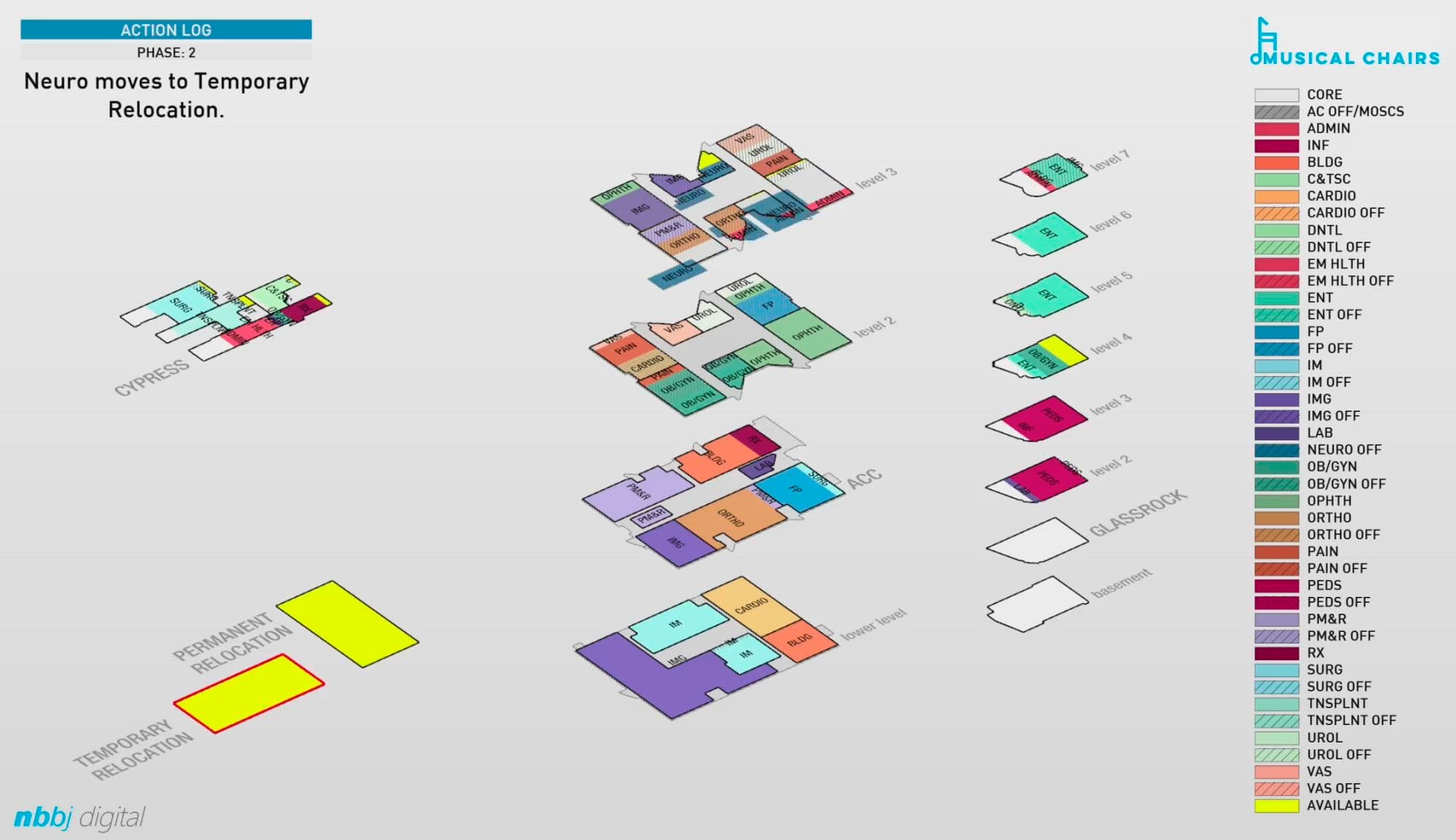
Simulation and modeling are especially valuable during this phase. They allow healthcare systems to visualize the future state before any physical move occurs—mapping how patients, staff and equipment will interact within the new environment. From phased move-ins to temporary layouts and alternative care pathways, modeling helps surface and solve potential challenges around flow, capacity and scheduling in advance.
Whether your organization is considering expansion but not yet ready to build, or in the middle of construction, the healthcare landscape is evolving rapidly, which means even the best plans must remain adaptable. By integrating creative, proactive solutions from the planning phase through post-occupancy, health systems can ease the transition and set themselves up for lasting success.
Interested in learning more about our master planning, transition planning, change management or simulation modeling services? We'd love to hear from you.