Great Buildings Don’t End with Architecture: How Environmental Graphic Design Extends the Story

Environmental graphic design does far more than help people find their way. When integrated from the earliest stages of design, it can bring nature into healthcare environments, support healing through art, express organizational values and create meaningful connections to place. This article explores four ways environmental graphics shape the human experience—and the projects that bring those ideas to life.
Environmental graphic design (EGD)—from signage and wayfinding to murals, artwork and immersive brand experiences—is often treated as the final layer of a project, applied after the architecture is complete to help people navigate a building or reinforce a brand. Yet research suggests this approach overlooks one of its most important roles: intuitive wayfinding has a direct impact on stress, particularly in healthcare settings where patients and families are already navigating uncertainty.
Unlike architecture, which shapes the physical environment, environmental graphics shape the human experience within it. They help people navigate, orient themselves and understand what makes a place unique. When considered from the outset, EGD can support healing, express culture, strengthen identity and create lasting connections to place.
The following themes illustrate how environmental graphic design becomes most powerful when it is woven into the design process from day one, with examples that demonstrate its impact across healthcare, workplace and training environments.
Bring the Outdoors In
UCSF Stad Center for Pediatric Pain, Palliative and Integrative Medicine, San Francisco, CA
Before designing a single graphic, NBBJ's environmental graphic design team met with pediatric patients, parents and caregivers at UCSF's Stad Center to understand what would make the environment feel supportive rather than clinical. The message was clear: no cartoon characters, primary colors or overly childish spaces. Instead, patients wanted to feel connected to nature and transported beyond the hospital setting. Inspired by Northern California's forests, waterways and grasslands, the resulting environmental graphics combine interactive three-dimensional elements and trompe l'oeil prints that create the illusion of landscapes extending beyond treatment room walls, transforming the clinic into a place of respite, play and imagination for patients of all ages.
Heal Through Art
Oregon Health & Science University Vista Pavilion, Portland, OR
For cancer patients undergoing stem cell treatments, highly compromised immune systems mean leaving the hospital is not an option. During planning for OHSU's Vista Pavilion, one patient shared that among the most difficult aspects of treatment was being unable to experience the outdoors for months at a time.
That conversation became the catalyst for a comprehensive healing art program integrated throughout the building. Through an open call across Oregon and Southwest Washington, the team commissioned 96 unique works from six artists, custom printed onto wall protection panels throughout the facility. Inspired by Oregon's landscapes and guided by evidence-based healing art principles, the collection creates moments of respite and connection to nature for patients and families. Its success has been so significant that OHSU has expanded similar healing art programs to multiple subsequent projects.

The extensive collection celebrates the forests, mountains, rivers and coastlines of the Pacific Northwest, helping patients maintain a connection to nature even when they cannot physically experience it.


Express Brand Values
Alaska Airlines Global Training Center, Renton, WA
Extending far beyond traditional signage, the environmental graphics program at Alaska Airlines' Global Training Center transforms a former 1990s-era office building into an immersive expression of the airline's culture, values and history. More than 60 sign types—from exterior identity and wayfinding to interpretive graphics—guide visitors through the building. A flexible Welcome Hall showcases company milestones and values, floor graphics inspired by a compass rose reinforce the spirit of travel and exploration, and installations crafted from recycled seatbelts, galley locks, marshaling wands, thread spools and personalized luggage tags embed the airline's aviation DNA directly into the interiors. Together, these elements create authentic connections to the airline's operations, reinforcing a sense of pride, purpose and belonging for employees.
Personify Company Culture
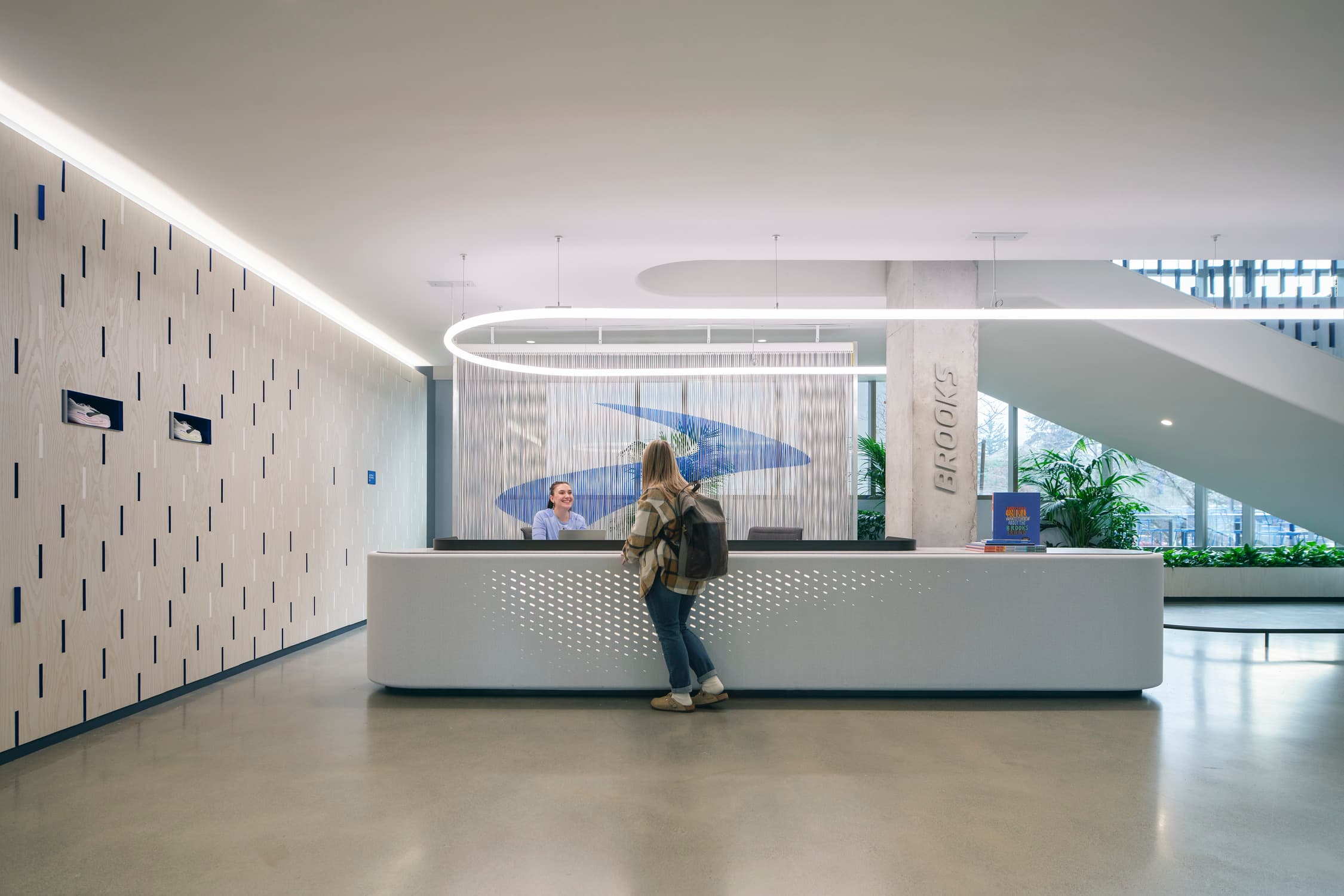
Brooks Running Headquarters, Seattle, WA
For Brooks Running, environmental graphics became an opportunity to transform the workplace into a physical manifestation of the company's mission, culture and connection to the running community.
Inspired by the idea of creating the "Center of the Running Universe," the graphics program draws from the visual language of running itself. Track lanes, trail markers, marathon distances, topographic maps and neighborhood running routes are woven throughout the building, creating moments of discovery for employees and visitors alike. The result is a workplace where every graphic element reinforces movement, exploration and the joy of running.

Wall graphics build on Brooks' "Let's Run There" slogan with messages that celebrate the company's history and culture, and stenciled patterns inspired by elevation, speed and running tracks flow across corridors and concrete walls.


Where Wayfinding Meets Experience
Environmental graphic design is most powerful when it begins with people. Whether helping a child feel less anxious during treatment, bringing the outdoors to patients who cannot leave their rooms, strengthening connections to company culture or telling stories that architecture alone cannot, it shapes how people experience a place. At its best, environmental graphic design transforms buildings from places people simply occupy into places they genuinely connect with.
Want to learn more about NBBJ’s environmental graphic design studio? Contact us.